Despite our best efforts, hard work and your ongoing support over the past 4 years, Scottish Ministers recently granted planning consent for Knockcronal and Craiginmoddie windfarms. This is terrible news for the community and local landscape. The only consolation is that the third scheme that was heard as part of the conjoined inquiry, Carrick, was refused consent.
For both Knockcronal and Craiginmoddie, the decision letters state that “Scottish Ministers are satisfied that the negative impacts are acceptable in the context of Scottish Government policy, and in the context of the net economic benefits and significant renewable energy benefits that the proposed Development would bring”. In short, local communities’ concerns count for nothing.
In relation to refusing consent for the Carrick scheme, the decision letter states that “Taking account of the Application, the EIA Report, AI Feb 2023, AI March 2023, the consultation responses, representations, the findings and the conclusions and recommendation of the PI Report, the Scottish Ministers consider that although many of the environmental impacts could be overcome by way of mitigation or would be overall acceptable when balanced against the net economic benefits and the renewable energy benefits that would be delivered if the proposed Development were to be deployed, the likely significant individual and cumulative landscape and visual impacts, impacting on the Dark Sky Park (and to some extent the Biosphere) would not.” Surely this argument would also apply to the Knockcronal and Craiginmoddie schemes, but reporters and ministers failed to recognise this.
Copies of the decision letters and reports for the three schemes can be downloaded from the DPEA case webpages at: Knockcronal, Craiginmoddie, Carrick. The map update below shows the context of the consented schemes on the local area.
We will continue to opose windfarm developments in the area, including the current proposal for Back Fell.
Yet another industrial wind power development is being proposed in our area. Vestas in partnership with Force 9 Energy are proposing a new development of 9 x 200m turbines on land between Straiton and Patna. The map above shows existing and proposed wind farm developments in the area, and the new Patna scheme. It also demonstrates how these schemes are gradually tightening the stranglehold around Straiton. Enough is enough!
The developer will be holding public exhibitions on Wednesday 1st October 2025 from;
1.00pm to 4.00pm at McCandlish Hall, Main St, Straiton, KA19 7NF, and
5.00pm to 8.30pm at Patna Community Centre, Whitehall Avenue, Patna, KA6 7LY
They say that they pride themselves on meaningful and ongoing community engagement, and before any decisions are made, they want to start a conversation with local residents. We urge you to attend to the Straiton session at 1.00pm on Wednesday 1st October to give them the “meaningful community engagement” they want, making it clear that the community objects and has serious concerns over the proposed development. If we can all arrive at the same time (1:00pm) it would have a greater impact but please attend whenever you can.
The developer has set up a website at https://patna.vestaswindprojects.com/ where you can find brief details of the scheme and leave comments if you can’t attend the public sessions.
We know from other local wind farm development proposals that;
200m turbines on high ground will have a significant impact on the landscape. The South Ayrshire Wind Capacity Study in 2018 recommended that turbines over 130m could not be accommodated in this landscape
Residences in the local villages will have dominating views of turbines from multiple schemes.
All wind farms are close to residences and the potential for noise and shadow flicker leading to a deterioration of the enjoyment of properties and potential health impacts.
These wind farms cannot be considered in isolation as there are others in the application stage which will contribute to the adverse impacts on communities.
The only way we can stop this new proposal is by making ourselves heard and seen. Your attendance at the Straiton session on the 1st October is a way of making your voice count.
Wind farm proposals south of Crosshill could have major impacts on the village including thousands of heavy goods vehicles passing along King Street and Dalhowan Street, with associated noise, disturbance, vibration, and pollution. In addition, there could be significant impacts on the local landscape and views. Object now to say ‘NO!’ to the latest wind farm development in the area.
Save Straiton for Scotland are reaching out to our neighbours in Crosshill to make you aware of a current planning application that has been submitted for 10 x 200m tall wind turbines at a site called Back Fell in the Glenalla and Dalmorton forests. Details can be found at www.energyconsents.scot/ApplicationDetails.aspx?cr=ECU00004830
Although the site is around 3 miles south of Crosshill, the image above shows how visible the Back Fell turbines would be. Indeed, the applicant admits in their planning application that…
“Significant effects would occur primarily within the Water of Girvan valley north and east of the Site. This includes views from within the settlement of Straiton, Crosshill, and Kirkmichael, which lies in the valley immediately north of the Site. The Proposed Development would have significant (Major) visual effects on the visual amenity of Straiton and a significant (Moderate) for Crosshill and Kirkmichael due to the greater distance from the Site.”
In addition, all ‘abnormal load’ traffic which would transport the 85m turbine blades and sections of the 165m tall towers would pass through Crosshill. These massive vehicle loads would cause disruption to residents of Crosshill in terms of suspension of all on-street parking on King Street and Dalhowan Street, multiple instances of the loads oversailing of footways, removal of street furniture and destruction of vegetation and trees. These massive vehicles would also create noise and pollution, and could cause vibrations that could lead to structural damage. The image below shows 57m turbine blades and tower sections being transported as part of a scheme in Shetland. The turbine blades that would come through Crosshill would be half as long again, at 85m in length.
You can also click here to see the results of ‘swept path analysis’ conducted by the applicant for 85m turbine blade vehicles passing through Crosshill. This illustrates how much space would be needed and shows these vehicles passing just feet from people’s front doors.
In total, the applicant suggests that over 3,500 construction vehicles could pass through Crosshill as part of the Back Fell development over an 18 month period. Save Straiton for Scotland considers this to be a huge underestimation of the true number of vehicles, as does Transport Scotland. Based on other proposed local wind farm schemes, Save Straiton for Scotland considers the true number to be nearly 13,000 vehicle trips.
Two other wind farm schemes in the area (Carrick and Craiginmoddie) that are currently being considered by the Scottish Government would also see construction traffic passing through Crosshill. Adding in construction trips for these other two schemes to the Back Fell proposals, could see over 86,000 construction vehicles passing through Crosshill over a period that could range from 18 months to over 4 years.
We have provided an objection template below which you are welcome to use / edit, sign and submit. The objection should be emailed to representations@gov.scot with a copy (cc) to planning.development@south-ayrshire.gov.uk Please could you also copy (cc) to savestraiton@gmail.com so that we can keep an eye on the ECU website for publication. You can also post a hard copy of your objection to Scottish Government Energy Consents Unit, 4th Floor, 5 Atlantic Quay, 150 Broomielaw, Glasgow, G2 8LU. You can also submit an objection to Econsents_Admin@gov.scot quoting Ref ECU00004830.
July 2025
To Whom It May Concern,
OBJECTION TO BACK FELL WIND FARM PROPOSAL (ECU00004830)
I am writing to formally object to the proposed Back Fell Wind Farm (ECU00004830) on the following grounds:
Visual Impact
The development would result in significant and irreversible visual harm, including the visibility of up to 10 turbines from multiple residential properties. Some homes will have as many as 7–10 turbines in direct view, with structures up to 200m tall. Even at a distance of around 3 miles from the site, the development would have a significant impact on the view from Crosshill looking south. The Residential Visual Amenity Assessment fails to offer site-specific reassessments or mitigation.
Traffic Access & Disturbance
The development would result in significant levels of construction traffic passing through Crosshill with associated noise, pollution, and disturbance. Of particular concern to residents of King Street and Dalhowan Street is vibration caused by construction and abnormal load vehicles which could lead to structural damage to the early 19th century planned village’s buildings. Swept path analysis shows abnormal load vehicles passing within feet of multiple properties.
Human Health and Wellbeing
There is no health or wellbeing assessment included in the application. Given the scale of the development and its proximity to homes, the absence of such an assessment is a serious omission. Noise, flicker, lighting, and stress-related impacts require proper consideration.
Lack of Net Biodiversity Gain
The proposal fails to demonstrate a meaningful net gain in biodiversity. Instead, mitigation and further assessments are frequently delayed until after consent, which offers no guarantees for environmental protection.
Ecological Risk
The proposal lacks adequate ecological safeguarding. Key species such as bats, pine martens, otters, and amphibians, including great crested newts (which are known to be present locally), are either under-assessed or not assessed at all. Habitat destruction and biodiversity loss are real risks.
Peatland Disturbance
The proposed site includes carbon-rich peatland. No intrusive core peat surveys or landslip risk modelling have been submitted pre-consent. Much of the peat risk management is deferred to post-consent, which is unacceptable for such a sensitive environment.
Landscape Capacity and Wind Energy Suitability
According to the South Ayrshire Landscape Wind Capacity Study (2018), the site falls within a landscape character type deemed to have low to moderate capacity for large turbines. The study warns that cumulative development in these upland fringe areas could exceed landscape thresholds and cause unacceptable visual intrusion, particularly affecting small communities like Straiton and isolated dwellings.
Overreliance on Post-Consent Safeguards
Across multiple technical reports, including peatland management, ecological mitigation, and hydrological risk, the developer relies heavily on safeguards and mitigation plans that are only promised after planning consent is granted. This means that many serious risks are left unresolved at the time of decision-making, which is contrary to best practice and inconsistent with the principles of environmental protection.
We understand that other applications on this site, involving smaller and fewer turbines have previously been rejected, and for all the reasons stated above, I urge you to reject this application also.
A Big Thank You to all who attended the AGM and Back Fell Wind Farm meeting yesterday, as well as those who spoke. Thanks also to the Afternoon Tea and Raffle teams, and the ‘Little Peru’ gang for their help with the clear up. It was great to see so many existing and new supporters. We really appreciate your time and effort.
We’re posting below a couple of maps that were shared at the meeting which people found helpful in assessing the scale of proposed wind farm development in our local area, as well as across East Ayrshire. These include Back Fell and the recently announced Herd Hill and Breezy Hill applications. As we’ve said many times before, “Enough is enough!”
We’re also sharing below a YouTube video that was referred to showing how much concrete and steel goes in to the base of just one wind turbine. The turbines in the video are smaller than those proposed around Straiton, so there’d be even more concrete and steel.
When we were clearing up the hall after the meeting, we found an MOT test certificate from last week. If this is yours, let us know at savestraiton@gmail.com and we can get it back to you.
Finally, if you still haven’t objected to Back Fell, you’ll find all the information you need in the previous posts below.
Save Straiton for Scotland invite you to a meeting on Sunday 6th July at 2.30pm in the McCandlish Hall, Straiton relating to the recently submitted planning application for Back Fell Windfarm.
The development would be located just over a mile southwest of Straiton and 2 miles southeast of Crosshill in an outstandingly beautiful area of South Ayrshire. It proposes up to 10 wind turbines with a tip height of approximately 200m and a total potential generating capacity of 62MW. The scheme also proposes approximately 30MW of battery energy storage.
Taken with other local proposed and existing wind power schemes, there could be 91 turbines up to 200m tall surrounding Straiton. Enough is enough!
Scheme
Status
No. Turbines
Back Fell
Proposed (Application)
10
Herd Hill
Proposed (Scoping)
12
Craiginmoddie
Proposed (Awaiting Decision)
14
Carrick
Proposed (Awaiting Decision)
13
Knockcronal
Proposed (Awaiting Decision)
9
Sclenteuch
Proposed (Awaiting Decision)
9
Knockkippen
Consented
12
Dersalloch
Operational
12
Total
91
All of these schemes will have significant impacts on the Girvan Valley, Straiton, surrounding communities and the wider landscape of South West Scotland which is already dominated by wind farms both operational and in the planning process.
The main issues of concern for the Back Fell scheme are:
The South Ayrshire Wind Capacity Study in 2018 recommended that turbines over 130m could not be accommodated in this landscape. Some homes would have 7 to 10 additional turbines in direct view up to 200m tall from this scheme alone, let alone other proposed and existing schemes.
Noise, shadow flicker, and lighting impacts have not fully explored or mitigated.
No human health or wellbeing impact assessments have been done.
Carbon-rich peatland will be disturbed, without proper pre-consent testing.
Protected species and habitats could be destroyed – yet some surveys (e.g. for amphibians like newts) have not been conducted.
Much of the risk analysis is deferred until “after consent”, meaning no guarantees for residents before it’s too late.
Further information is required to ensure we have assurances that there will be zero risk to private water supply both during construction and beyond.
The scheme contravenes and / or is inconsistent with many of the policies of National Planning Framework 4.
Save Straiton for Scotland are calling for people across the local and wider area to object to the proposed Back Fell Wind Farm. The development would be located just over a mile southwest of Straiton and 2 miles southeast of Crosshill in an outstandingly beautiful area of South Ayrshire. It proposes up to 10 wind turbines with a tip height of approximately 200m and a total potential generating capacity of 62MW. The scheme also proposes approximately 30MW of battery energy storage. Taken with other local proposed and existing wind power schemes, there could be 91 turbines up to 200m tall surrounding Straiton as shown in the map below. Enough is enough!
The developer’s own Environmental Impact Assessment highlights a range of risks to our landscape, wildlife, water, and residential amenity, including impacts on numerous properties, viewpoints, and local landmarks and Local Landscape Areas (such as the Water of Girvan). Full application documents can be found at;
We believe this development is in the wrong location. It raises too many unanswered questions and threatens to cause lasting harm to our shared landscape, fragile ecosystems, local economy, and overall quality of life. The visual and environmental impacts not only would seriously impact on local residents, but could also deter visitors, damage the area’s reputation as a peaceful rural destination, and create real financial consequences for local businesses that rely on tourism, hospitality, and outdoor recreation.
Serious concerns relate to:
200m turbines on high ground will have a significant impact on the landscape. The South Ayrshire Wind Capacity Study in 2018 recommended that turbines over 130m could not be accommodated in this landscape. Some homes would have 7–10 additional turbines in direct view up to 200m tall from this scheme alone, let alone other proposed and existing schemes.
Noise, shadow flicker, and lighting impacts have not been fully explored or mitigated.
No human health or wellbeing impact assessments have been done.
Carbon-rich peatland will be disturbed, without proper pre-consent testing.
Protected species and habitats could be destroyed – yet some surveys (e.g. for amphibians like newts) have not been conducted.
Much of the risk analysis is deferred until “after consent” – meaning no guarantees for residents before it’s too late.
Private water supply impact – further information is required to ensure we have assurances that there will be zero risk to private water supply both during construction and beyond.
The scheme contravenes and / or is inconsistent with many of the policies of National Planning Framework 4.
We’re asking for everyone to submit an objection by 28th June 2025.
There is evidence that windfarm developments, such as the nearby Clauchrie scheme, can, and have been refused planning consent but to do so, we need local objections to be heard. Whether you feel directly affected or simply want to support your community and help preserve the character and biodiversity of our shared environment, your voice matters.
We have provided an objection template below which you are welcome to use / edit, sign and submit. There is also a list of email addresses to send the objection to. At a minimum,the objection should be emailed to representations@gov.scot with a copy (cc) to planning.development@south-ayrshire.gov.uk Please could you also copy (cc) to savestraiton@gmail.com so that we can keep an eye on the ECU website for publication. You can also post a hard copy of your objection to Scottish Government Energy Consents Unit, 4th Floor, 5 Atlantic Quay, 150 Broomielaw, Glasgow, G2 8LU.
June 2025
To Whom It May Concern,
OBJECTION TO BACK FELL WIND FARM PROPOSAL (ECU00004830)
I am writing to formally object to the proposed Back Fell Wind Farm (ECU00004830) on the following grounds:
Visual Impact
The development would result in significant and irreversible visual harm, including the visibility of up to 10 turbines from multiple residential properties. Some homes will have as many as 7–10 turbines in direct view, with structures up to 200m tall. The Residential Visual Amenity Assessment fails to offer site-specific reassessments or mitigation.
Private Water Supply
Under the Water Framework Directive, the Precautionary Principle is a fundamental requirement for groundwater protection which requires zero deterioration of designated groundwater status. The development area is located within a statutory designated groundwater protection area with “Good” status under SEPA’s classification. The Water Framework Directive explicitly prohibits even temporary deterioration of this designated status, yet the submitted Environmental Impact Assessment provides no guarantee that construction activities will not cause such deterioration. We need to seek for the developer to assure that there will be zero deterioration both during construction and for the duration after.
Ecological Risk
The proposal lacks adequate ecological safeguarding. Key species such as bats, pine martens, otters and amphibians, including great crested newts (which are known to be present locally), are either under-assessed or not assessed at all. Habitat destruction and biodiversity loss are real risks.
Peatland Disturbance
The proposed site includes carbon-rich peatland. No intrusive core peat surveys or landslip risk modelling have been submitted pre-consent. Much of the peat risk management is deferred to post-consent, which is unacceptable for such a sensitive environment.
Human Health and Wellbeing
There is no health or wellbeing assessment included in the application. Given the scale of the development and its proximity to homes, the absence of such an assessment is a serious omission. Noise, flicker, lighting and stress-related impacts require proper consideration.
Lack of Net Biodiversity Gain
The proposal fails to demonstrate a meaningful net gain in biodiversity. Instead, mitigation and further assessments are frequently delayed until after consent, which offers no guarantees for environmental protection.
Incompatibility with Local and National Environmental Objectives
The site is within the Galloway and Southern Ayrshire UNESCO Biosphere and adjacent to a Site of Special Scientific Interest. The development is at odds with the ethos of protection, restoration and enhancement expected within these designations and runs counter to the principles of National Planning Framework 4 (NPF4).
Potential Impact on Ailsa Craig SPA and Migratory Birds
The ornithology report acknowledges the existence of the Ailsa Craig Special Protection Area (SPA), designated for its internationally significant seabird populations. However, the report fails to provide site-specific data on migratory or foraging movements that may intersect with the development zone. No vantage point surveys or radar tracking were undertaken to determine whether SPA species use this corridor during migration or post-breeding dispersal. These gaps could lead to underestimation of collision risks and breach the precautionary principle under the Conservation of Habitats and Species Regulations 2017.
Landscape Capacity and Wind Energy Suitability
According to the South Ayrshire Landscape Wind Capacity Study (2018), the site falls within a landscape character type deemed to have low to moderate capacity for large turbines. The study warns that cumulative development in these upland fringe areas could exceed landscape thresholds and cause unacceptable visual intrusion, particularly affecting small communities like Straiton and isolated dwellings.
Overreliance on Post-Consent Safeguards
Across multiple technical reports, including peatland management, ecological mitigation, and hydrological risk, the developer relies heavily on safeguards and mitigation plans that are only promised after planning consent is granted. This means that many serious risks are left unresolved at the time of decision-making, which is contrary to best practice and inconsistent with the principles of environmental protection.
Significant adverse effects on Water of Girvan Local Landscape Area (LLA)
By the Developers own admission, “this proposal would be partly located in the Water of Girvan Valley LLA and we consider that it is likely that significant adverse effects will occur on the character and qualities of this designated landscape” and “views from the valley containing the Water of Girvan which is recognised as an LLA and is important for tourism. Furthermore, they also go on to say that a key concern “…is [the] cumulative effects with the proposed Sclenteuch wind farm which we consider are likely to be significant, principally affecting landscape character and views in the upper Girvan valley and around Straiton”
We understand that other applications on this site, involving smaller and fewer turbines have previously been rejected, and for all the reasons stated above, I urge you to reject this application also.
Following on from two ‘public consultation’ exercises last year, a planning application has just been submitted to the Scottish Government for Back Fell Wind Farm. Application documents can be accessed at;
The proposed development is located just over a mile southwest of Straiton and 2 miles southeast of Crosshill. It proposes up to 10 wind turbines with a tip height of approximately 200m and a total potential generating capacity of 62MW. The scheme also proposes approximately 30MW of battery energy storage and associated access roads. The site boundary is shown on the map extract below.
Save Straiton for Scotland are currently assessing the submission to formulate an objection and a way forward. We will update you further in due course. In the meantime, you can submit an objection to Econsents_Admin@gov.scot quoting Ref ECU00004830, and contact your local elected representatives to urge them to object to the scheme.
We are sad to announce the passing of Susan Crosthwaite on 6th January, long term campaigner and expert of the ill effects of noise from wind turbines. Susan provided unrivalled assistance to Save Straiton for Scotland as part of the conjoined inquiry in to three industrial wind power schemes around Straiton. She will be sadly missed.
A recent interesting article from Motvind, a non-profit environmental consultancy that specializes in helping local communities to understand, and oppose, grid scale wind farm developments. The issues raised are certainly pertinent to the proposed wind power developments around Straiton.
There are two components to “safe set-back distances”: the threat to the health of both humans and livestock, and the Health and Safety requirements on the part of Highway Regulations. The latter is more easily dealt with and clearer: a safe distance for a wind turbine from a public highway is the blade-tip height plus 50 metres.
The threat to human health, psychological well-being and community coherence is more controversial, largely because research into the effects of industrial wind turbines has had to be reactive to the original claims and distortions of turbine manufacturers and developers. Governments accepted these claims and inadequate acoustic standards so did not impose or even recommend safe set-back distances between turbines and residences, whether for humans or livestock.
Since the turbines went up evidence has steadily accrued from medical experts world-wide, from local authorities, overseas governments, surveyors, and acoustic consultants all recommending safe precautionary distances. It has been the research into infrasound, inaudible to humans but experienced viscerally, which originated with Defence Studies then moved into research commissioned by responsible bodies into its impact upon health, sleep and depression, which has alarmed Health Authorities. Research is also now emerging about Amplitude Modulation in audible and inaudible noise, which again developers denied.
The main conclusions of this research are that:
All wind turbines cause it.
Heightened Noise Zones are created (HNZs).
As readings gain distance, low frequency waves begin to dominate at 1 km plus.
Erratic and sudden changes in frequency levels, which add to the psycho-acoustic annoyance
Multiple arrays add to the noise levels, and the range of low frequency impact.
Developers now accept that a 3dB level should have applied, rather than the 10-20 dB, which they have hitherto invoked as safe! As a result, the World Health Organisation has extended its definition of Public Health to include “social well-being,” to safeguard against the distress, annoyance and social disunity provoked by wind farms in particular. Public Health authorities in the UK have not yet responded.
Local authorities in the UK have struggled to protect their residents against central planning diktats. Some have tried to introduce a set-back distance of between 1.5 and 2km, others have tried to set up zones away from homes. Overseas, the range is between 2km and 3.2km. Surveyors recommend 1.6km, scientific acoustic consultants recommend 2km, the same as the Renewable Energy Foundation.
Different authorities and tiers of government have attempted various strategies to limit the powers of developers, who use their government policy backing to frustrate democratic processes. In Denmark, developers have to compensate residents for any falls in their property value. In Texas and Australia developers can be sued for both loss of property values and threats to their health and amenities. Here in the UK government action has been more timid, with only local attempts to constrain turbines to brown-field sites or limited zones. The new government in Australia is threatening to introduce legislation, (based on the mis-selling of bank products) that would give retrospective compensation to residents from developers.
Following on from their first public exhibition in March this year, the developer of the proposed wind power plant at Back Fell, Straiton (12 x 200m turbines plus battery storage facilities) will be holding a second public exhibition on Thursday 23rd May 2024:
15.00 – 18.00 – Crosshill Community Centre, 34 Kirkmichael Road, Crosshill, KA19 7RJ
They say that the exhibition will give the E Power team the opportunity to update us on progress with the project and to answer any questions we may have. If they had really listened to the local community, they would have given up on this crazy scheme. Let’s see how they talk their way out of this one. Given that there was an unprecedented turn-out of the local community in opposition to the scheme at the March evening session, has the morning session next Thursday been scheduled to limit the potential of a large turn-out again?
The exhibition materials from March are still available online at the project website, https://backfellinfo.co.uk/ along with a questionnaire for residents who are unable to attend the exhibition.
We urge you to attend to the Straiton session on Thursday 23rd May at 12:00 to make clear the community objection and concern over the proposed development.
As a reminder, this is on the old Knockskae site in Glenalla forest but takes in Dalmorton forest with the proposal now being for 12 x 200m turbines. The scheme would be much nearer Straiton than any of the 3 schemes that are currently the subject of a public inquiry with multiple turbines being in close proximity to residential properties, such as Knockskae, Little Garroch, Balbeg, Dyke, and Knockgardner. The map below shows the application site boundary.
The three schemes that are currently the subject of a public inquiry are Knockcronal, Carrick and Craiginmoddie. In addition, the Sclenteuch wind farm proposal is also currently being considered. In total these schemes would see 53 x 200m turbines around the village. The Back Fell scheme would see this increase to 65 x 200m turbines.
All of these schemes will have significant impacts on the Girvan Valley, Straiton, surrounding communities and the wider landscape of South West Scotland which is already dominated by wind farms both operational and in the planning process.
The only way we can continue to fight this proposal is by making ourselves heard and seen. Your attendance at the Straiton session on the 23rd May is vital. Please forward this post to anyone you know so we can maximise turnout and demonstrate to the developer that this senseless development cannot be allowed to proceed.
The Maybole, North Carrick and Coylton SNP Branch has recently been in contact with us to confirm their support, and that of the wider local party, for Save Straiton for Scotland and our opposition to the proliferation of industrial wind power developments in the area. Their correspondence reads…
Our SNP Branch meeting took place in Maybole last Monday. Our Branch members were in full agreement that we objected completely to the Back Fell Wind Farm proposal near Straiton.
We continue to believe Green Energy and Net Zero are vital strategies to reduce the impact of global warming. However, we believe that in North Carrick ‘enough is enough’ describes our views about recent wind farm proposals. We will continue to object to wind farms on a case-by-case basis and especially on the grounds of cumulative effect in parts of South and East Ayrshire. We also sought support from our SNP elected representatives at local, Scottish and UK Government levels and all our local representatives support our objections.
We thank the group for letting us know and their support.
If you haven’t already, please help us by objecting to the Scottish Government’s Energy Consent Unit (ECU) on the proposed Sclenteuch Wind Farm.
RES who applied to build the Keirs Hill wind farm which was turned down in 2016 on landscape and residential amenity grounds following a public enquiry, have applied to build a further wind farm on Keirs Hill with some turbines coming closer to Straiton. The scheme was assessed to have a very serious visual impact based on 149.9m height of the turbines. The current proposal for Sclenteuch is for 6 x 200m and 3 x 180m turbines and hence even worse than the previously refused scheme. Despite this, both East Ayrshire Council and South Ayrshire Council have now submitted their reports to the ECU with neither council objecting to the scheme. The turbines, in the forests directly opposite to the Dersalloch wind farm, would be seen from Straiton and the roads leading into the village, and similarly for our friends in Patna and Waterside. The East Ayrshire Council report can be found here, while the South Ayrshire Council report can be found here.
In addition to the apparent U-turn on the scheme’s acceptability, contradictions on a range of other issues, and from a variety of consultees, are present in the councils’ reports;
East Ayrshire Planning Report
NatureScot advise that the proposed development would result in significant day time and night time impacts on the Wild Land Qualities of the Merrick Wild Land Area, significant effects of turbine lighting and other significant landscape and visual effects.
When assessed against National Planning Framework 4, the Council found the scheme to have significant adverse impacts on Local Landscape Areas and Sensitive Landscape Areas and significant landscape effects to parts of the Doon Valley LLA/SLA north of Dalmellington.
In terms of the residential visual amenity impacts there will be significant adverse impacts resulting from the scheme, including through the impacts extending into the hours of darkness with the visible aviation lighting over and above the daytime impacts.
Significant adverse impacts on public access, long distance walking and cycling routes and scenic routes.
National Air Traffic Control and Glasgow Prestwich Airport both object to the proposal
Despite these areas of significant impact and objections, East Ayrshire Council has not objected to the scheme.
South Ayrshire Council Planning Report
The proposal has the potential to have some adverse effects on the road network with an increase in vehicles including HGVs during the temporary construction phase.
The windfarm has the potential to have some limited adverse effects on the setting of Straiton which is a historic settlement with a Conservation Area and a large number of Listed Buildings. The greatest impact would be from the wind farms elevated position which would see it sit above the settlement in views from the west. This has the potential for an adverse effect in some views where the settlement can be seen in combination with the wind farm.
Significant effects are likely in terms of residential visual amenity on properties within Gass.
There is the potential for significant adverse effects on the landscape from this development given its scale and height of turbines.
The proposed development would have some significant adverse effects on the Carrick Hills Local Landscape Area
National Air Traffic Control and Glasgow Prestwich Airport both object to the proposal
The Council’s landscape consultant concludes that there would be significant adverse effects on residential properties centred on Gass Farm where the addition of the proposed development to a baseline which includes the existing Dersalloch wind farm would be likely to result in an overwhelming effect, as well as significant adverse effects on the special qualities and character of the High Carrick Hills LLA, notably on the sense of wildness associated with this landscape and affecting views from popular hill summits.
The Proposed Development would result in significant adverse effects on the eastern part of the Middle Dale LCT (the Girvan valley) where the very large turbines of the proposal would form a prominent feature seen on low skylines on the edges of Sclenteuch and Cloncaird Moors
Despite these areas of significant impact and objections, South Ayrshire Council has not objected to the scheme.
Save Straiton for Scotland has lodged an objection to the Energy Consents Unit and we would urge you to object to the proposal due to the adverse impacts resulting from this development. It is not too late to object to this proposal. Objections can be made to the ECU by email to Econsents_Admin@gov.scot quoting the reference number ECU00003318 and the title Sclenteuch Wind Farm. Your objection should be signed off with your name and address.
You could cut and paste the following if it would make it easier:
Sclenteuch Wind Farm Reference ECU00003318
I am writing to lodge my objection to the proposed Sclenteuch industrial wind power station for 6 x 200m and 3 x 180m turbines which would have a damaging effect on the villages of Straiton, Patna and Waterside. Please therefore take this email as an objection to the proposal.
Add your name and address before signing off.
Alternatively, you could prepare your own objection perhaps based on the SSfS’s objection which might include the following:
Landscape and Visual
The reporter for the Keirs Hill PLI concluded in 2016 that “there would be seriously adverse landscape impacts because of the height of the proposed turbines in relation to the scale of the landform on which the site is located. This would be particularly damaging when seen from the Doon Valley and the hills to the south. There would be serious visual impacts for properties at Waterside and the immediate surrounding area, and for parts of Patna. This would be because of the height and proximity of the turbines.”
This application was for turbines of 149m and turbines of 180m and 200m would extend the landscape impact on Patna and Waterside to Straiton. It would be concluded that this impact would still exist but affecting the wider community.
For turbines of this size aviation lighting would be required at night which is going to impact on the Dark Sky Park. The lighting would therefore constitute a threat to the designation of the DSP due to light pollution but the lighting would impact on the landscape at night with the possibility of flickering and the blades pass the lights on the towers.
Cultural Heritage
In 2016 the reporter for the Keirs Hill PLI concluded that “there would be adverse impacts on the historic estate at Waterside. This would be because of the proximity and height of the turbines which would have an adverse impact on the setting of scheduled monuments, listed buildings and the conservation area”. This would remain as an adverse impact on the cultural heritage of the Doon Valley but extended to the cultural setting of Straiton.
Ecology
The applicant has assessed the size of the proposal as being medium as it consists of fewer than 10 wind turbines (small project size) and has one other operational wind development within 5 km (medium size). It is not clear of the relevance of this assessment and it would seem to imply that the impact is somehow reduced. While the number of turbines at 9 is below 10 the impact of 200m turbines could be considerable and significant. 200m turbines could have a swept area of over 17,000 square meters or 1.7ha. 9 turbines would therefore present a significant obstacle for bats and birds.
The applicant has noted that there were failures in the recording equipment for bats and that there were suboptimal conditions for bat activity during the survey. This would lead to questioning the thoroughness of the survey.
Geology, Hydrology and Hydrogeology
The applicant states that the layout of the proposed development has been altered to take into account areas of deep peat but as this area contains extensive areas of deep peat they could be difficult to avoid.
Some turbines are adjacent to the Lochhead Burn and areas of deep peat. The construction of the turbine bases and the connecting roads have the potential to impact on these areas of deep peat. Being adjacent to a water course feeding into the Lochhead Burn there is the risk of pollution to these burns and Loch Spallander.
Traffic & Transport
It is considered that the impact from the construction of the wind farm on the communities of Patna, Waterside, Dalmellington and Straiton will create at least a nuisance. Further it is considered that the level of detail submitted in support of the application in terms of cumulative impact from other windfarm schemes which may be consented is insufficient for a full assessment to be made.
Assessment of Need
South Ayrshire Council’s supplementary submission on energy and planning policy in relation to the recent Clauchrie Wind Farm application set out why additional provision is not required and stated that:
“While the Scottish Ministers are setting an ambition for an additional 8-12GW of onshore wind capacity by 2030 it is clear that this can be met by the existing pipeline of consented developments (5GW), with extensions to current consented sites (1.3GW) and by repowering older end of life developments (5GW). Kilgallioch and Arecleoch extensions have been approved since this statement was made. There is therefore no need for additional consents on new virgin site to meet the ambition.”
In summary, there is evidence that demonstrates that additional onshore wind provision as would be provided by the proposed windfarm development at Sclenteuch is not required. The failings of the current windfarm economic case demonstrates that additional onshore wind provision will lead to further, unsustainable costs for consumers, while the wind farm operators are receiving substantial constraint payments.
Socio Economics and Tourism
The developer is dismissive of the effect that windfarms have on tourism, not taking into account why visitors choose some areas over others. VisitScotland has said that tourism is crucial to Scotland’s economic and cultural well-being. It sustains a great diversity of businesses throughout the country. According to a recent independent report by Deloitte, tourism generates £11 billion for the economy and employs over 200,000 – 9% of the Scottish workforce. Tourism provides jobs in the private sector and stimulates the regeneration of urban and rural areas. One of the Scottish Government and VisitScotland’s key ambitions is to grow tourism revenues and make Scotland one of the world’s foremost tourist destinations.
In July 2016 the reporter for the Keirs Hill Enquiry concluded – “Impacts on tourism and recreation are difficult to be precise about and there is no confirmed evidence as to wind farms deterring tourists from visiting areas where they are located. Despite this the local economy is fragile and communities in the Doon Valley are trying to promote tourist based growth following the loss of the coal industry. Any small loss of income could have a significant adverse impact on the local economy.” The same would apply in the Straiton locality which similarly derives much of the local income from tourism.
A BIG THANK YOU to all those who attended the developer’s ‘public exhibition’ on Tuesday. It was great to see so many of you showing your opposition to the scheme. The numbers attending took the developer by surprise, with a member of their team saying it was the largest turnout they had seen.
If you haven’t already, or were unable to attend, please complete the developer’s questionnaire at https://backfellinfo.co.uk/community/questionnaire/ and don’t hold back! Details of the scheme can also be found on the developer’s website.
Just a reminder that the developer is holding a Public exhibition this afternoon at the McCandlish Hall. We are urging all who can attend to do so at 5pm to demonstrate opposition to the scheme which would be a further blight on the village.
Last autumn we let you know about a scoping report that had been submitted to the Scottish Government for a wind power plant development at Back Fell (Glenalla forest / Dalmorton forest) with the proposal being 14 x 200m turbines.
The developer is progressing plans for the scheme and will be holding their first public exhibition on Tuesday 5th March 2024, details below,
10.00 – 14.00 – Crosshill Community Centre, 34 Kirkmichael Road, Crosshill, KA19 7RJ
They say that the exhibition will give the E Power team the opportunity to introduce the project to residents and to answer any questions they may have. All the exhibition materials will be available online at the project website, https://backfellinfo.co.uk/, from 5th March with a feedback form for residents who are unable to attend the exhibition. Shame that they are not making this information available ahead of the event – so much for openness and transparency!
We urge you to attend to the Straiton session on Tuesday 5th Marchat 17:00 to make clear the community objection and concern over the proposed development.
As a reminder, this is on the old Knockskae site in Glenalla forest but takes in Dalmorton forest with the proposal being 14 x 200m turbines. The applicant states that the village of Straiton will be approximately 900m from the site which is much nearer than any of the 3 schemes that are currently the subject of a public inquiry. The nearest turbines will be approximately 1km from Knockskae, Little Garroch, Balbeg, Dyke, and Knockgardner, and the application area bounds with the Straiton, Dyke and Knockgarder road. Copies of the Scoping Report and the proposed site layout can be downloaded from https://www.energyconsents.scot/ApplicationDetails.aspx?cr=ECU00004830 while the map below shows the application site boundary.
The three schemes that are currently the subject of a public inquiry are; Knockcronal by Statkraft for 9 x 200m turbines, Carrick by Scottish Power Renewables for 17 x 200m turbines and Craiginmoddie by Energiekontor for 18 x 200m turbines. In addition, the Sclenteuch wind farm proposal is also currently being considered which will be in the forests to the west of the Dersalloch wind farm and will consist of 9 x 200m turbines. All of these schemes will have significant impacts on the Girvan Valley, Straiton, surrounding communities and the wider landscape of South West Scotland which is already dominated by wind farms both operational and in the planning process.
The main issues of concern are:
200m turbines on high ground will have a significant impact on the landscape. The South Ayrshire Wind Capacity Study in 2018 recommended that turbines over 130m could not be accommodated in this landscape.
Schemes are very close to Wild Land areas and will impact significantly on the setting of the wild land designation by introducing man made and moving features in the landscape.
Residences in the local villages will have dominating views of turbines from multiple schemes.
All wind farms are close to residences and the potential for noise and shadow flicker leading to a deterioration of the enjoyment of properties and potential health impacts.
These wind farms cannot be considered in isolation as there are others in the application stage which will contribute to the adverse impacts on communities.
The only way we can fight this new proposal is by making ourselves heard and seen. Your attendance at the Straiton session on the 5th March is vital.
Please forward this post to anyone you know so we can maximise turnout and demonstrate to the developer that this shameless development cannot be allowed to proceed.
18 x 200m Turbines Located between Barr and Pinwherry, South Ayrshire
Email: econsents_admin@gov.scot
Ref: Knockodhar Wind Farm ECU00002153
Knockodhar is to be considered by South Ayrshire Council at a meeting on 1st February 2024. This application if approved will fill in the gap between Hadyard Hill (52 turbines) and Markhill (30 odd) which is north of Arecleoch and Kilgallioch (some 140). While this is outside of the remit of Save Straiton please object as it is another application which are coming thick and fast in the area and all over Scotland. Please send an objection to the members of the council indicating the strength of opposition to further wind farm development in this area. If you cannot object, then please take note that this is yet another application for an industrial power plant in the area. The current council members for the immediate area are:
A simple email stating that there are already far too many wind farms in South Ayrshire and you hope the council will reject this application should suffice. Or you can use the following as an objection simply cut and paste or amend as appropriate and email to econsents_admin@gov.scot
Ref: Knockodhar Wind Farm ECU00002153
I understand that the Council is to consider this application on 1st February, and I would urge the council to strongly object to this application for the following reasons.
The development will have a significant and detrimental effect on the landscape in the area of Pinwherry, Barr and Colmonell and the Landscape Character Types designated by South Ayrshire Council LCT 18c and LCT 13 in this area.
In conjunction with other existing wind farms, it will have a significant and detrimental effect on views from recreational routes in the area as well as the A714 and the B734 with potential to further damage the Merrick Wild Land area. Clauchrie was turned down by the Scottish Government because it was felt to unduly spoil the enjoyment of people visiting The Merrick in the same way that Carrick, Knockcronal and Craiginmoddie, Blair Hill and the others nearer to Newton Stewart would do also. Knockodhar adjacent to the Clauchrie site has the same effect.
There are now twenty-one wind farms within 20 km of the proposed development comprising over 430 turbines in total, this is too much of an intrusion into the peace and quiet of the area. South Scotland has 5% if the country’s population and already more than 20% of Scottish turbines. It is already capable of producing many time the electricity which will ever be consumed in the area.
Access to the proposed Development will be from the small village of Pinwherry on the A714, a winding road, wholly unsuitable for heavy construction traffic. The construction traffic, over 100 HGV movements a day, coupled with the impact of other wind farms under construction will completely alter the character of the village of Pinwherry.
Deep groundwork for turbine bases and borrow pits together with the requirements to manufacture 37,000 tonnes of concrete will significantly impact the hydrology of the area which is already subject to water problems during dry weather.
Aviation lighting which is required on turbines over 150m will damage the dark Sky Park, the Biosphere and other important tourist attractions in the area as well as impacting on the landscape during the nighttime.
Estimates of noise and shadow flicker are based upon out of date methodology and give misleading results. There is already a history of properties being bought up by the ‘developer’ or abandoned due to shadow flicker. The impact of noise if based on guidance drawn up by the wind power plant industry in 1997 and is in need of urgent revision.
The development will not make a significant contribution to reduced emissions because the grid cannot accommodate the proposed output.
Below is a recent post from the Save Our Hills Facebook page which makes interesting reading and shows the smoke and mirrors approach used by windfarm developers. Hill of fare windfarm
Today we are talking about the carbon footprint of the Hill of Fare windfarm. This is the carbon emitted due to the construction of the turbines, roads, borrow pits, etc. and includes carbon losses due to peat removal and tree feeling.
Using the Scottish Government’s Carbon Calculator, RES has calculated that the carbon emitted by building the Hill of Fare windfarm amounts to some 210,637 tonnes equivalent of CO2, reducing to 192,477 after proposed enhancement of the site (specifically improving degraded bogs, felled forestry, restoration of peat from borrow pits and drainage).
This is a very large number due to the amount of pristine peat removed. We are looking into RES’ data and assumptions to make sure that this is correct, but this is not easy, so we are taking these figures at face value.
Once windfarms are in operation they deliver carbon-free electricity and displace carbon emissions which would otherwise result from energy generation by fossil fuels (usually gas). The ‘carbon payback’ time is a standard way to estimate how long the wind farm will take to offset the carbon emitted because of its construction and operation.
RES claim a ‘carbon payback’ time of 2.8 years for this windfarm, assuming the grid mix of today (44% fossil fuels) remaining constant for its 50 year lifetime.
However, the grid mix is de-carbonising rapidly as more and more windfarms are brought onstream displacing fossil fuels. We have sourced grid mix data for 2024-2029 from UK Gov Annex B: Carbon dioxide emissions by source (revised 10 March 2023), and 2030-2040 from UK Gov BERR net zero and the Power Sector Scenarios (February 2022).
These indicate a rapid decline in fossil fuels in the grid mix. The UK Dept of Business Energy and Industrial Strategy (BERR) states ‘overtime, low carbon generation increases. In all four scenarios, from 2035 onwards, low carbon generation makes up more than 99% of domestic generation. In 2030, low carbon generation is 90-93% of domestic generation.’
Although there is some uncertainty around these figures, the trends are clear as more and more windfarms start generating low carbon electricity.
If approved, we estimate that the Hill of Fare windfarm will start generating electricity around 2029, by which time the grid mix will be around 10% fossil fuels. By 2035 this is predicted to fall to around 1% and to remain at that level. Using these assumptions, we have modelled the Hill of Fare windfarm carbon payback period.
We conclude that it will NEVER payback the carbon generated in construction and removal of peat and trees. Overall, the windfarm is a carbon source and does not contribute to getting to net zero. The main reason for this is the removal of undegraded peat which results in a high carbon footprint.
Windfarms that involve destroying a lot of peat should never be built. The following published papers make the same conclusions:
The total number of wind turbines in Scotland is currently 4,273 spread over 334 wind power stations, there are further 29 wind power stations under construction comprising a further 640 turbines. There are an additional 96 wind power station sites consented and awaiting construction which will add another 1,058 turbines and there are also applications under consideration for a further 115 sites and 1,555 turbines. When that is complete, there will be 7,526 turbines and 574 operational wind power stations in Scotland although Scotland Against Spin reckon that is an understatement.
Data for South Ayrshire is not fully up to date, but South Ayrshire Council’s interactive map is presently being updated and should be fully up to date by Christmas. The map extract below shows current and proposed industrial wind power plants surrounding Straiton, but does not yet include the recent Back Fell proposal. The full map can be accessed here.
Scotland already has over 9,390MW of onshore wind capacity and Dumfries and Galloway is one of the top 3 local authority areas for onshore wind with almost 2,000MW capacity within or on its borders. D&G is already a net exporter of electricity having generation capacity for 15 times the number of homes in the region or projected to be in the region by 2028.
Data for Dumfries and Galloway only as at 27.08.2023:
Turbines
538 turbines in operation
367 turbines consented and awaiting construction428 turbines in planning (many of these are significantly taller than those in operation)
69 turbines in scoping
1402 turbines in total
Wind power stations
29 wind power stations in operation
27 wind power stations consented and awaiting construction
The Scottish Government’s Energy Consent Unit has published its response to the Back Fell Scoping Report by E Power Ltd. The Scoping Response document can be downloaded here.
To recap, the proposed development would be located approximately 900m south of Straiton and is situated on uplands with a large area of commercial forestry and is anticipated to comprise up to 14 wind turbines with a tip height of approximately 200m. In addition to wind turbines there will be ancillary infrastructure including: crane hard standings and laydown area adjacent to each wind turbine; turbine foundations; power cables, linking the wind turbines, laid in trenches underground, including cable markers; a control building including substation, parking, and a small storage compound; battery storage compound, located adjacent to the substation compound; permanent and temporary power performance assessment (PPA) anemometry mast; new and upgraded access tracks, passing places and turning heads; drainage works; borrow pits; temporary construction compound and aviation warning lights.
The purpose of the ECU’s consultation was to obtain scoping advice from a range of consultees on environmental matters within their remit. Despite our request to the ECU, Save Straiton for Scotland was not included in the list of consultees. We are working to ascertain why we had not been included.
The Energy Consent Unit sets out in the report that ‘Scottish Ministers are satisfied with the scope of the EIA set out in the scoping report’ but acknowledges that additional information will be required as part of any formal planning application. In short, the report only deals with procedural matters, setting out what will be required for a planning application. It does not express an opinion as to whether the proposal would be supported or refused. A summary of key consultation responses is set out below;
South Ayrshire Council agree with the general methodology but will require additional information / assessments including landscape and visual impact, noise, access and water supplies.
Scottish Environment Protection Agency agree with the general methodology but will require additional information / assessments on watercourses, peat, mitigation and repowering / decommissioning.
Nature Scot agree with the general methodology but will require additional information / assessments on impacts on Special Protected Areas, Sites of Special Scientific Interest, landscape and visual amenity, protected species, habitat management and peatland.
Historic Environment Scotland agree with the general methodology but will require additional information / assessments and have particular concerns regarding impacts on Knockinculloch, land NW of Glenalla and Blairquhan.
Transport Scotland agree with the general methodology but will require additional information / assessments on access routing.
Scottish Forestry set out impacts will be significant and will require full details on felling and compensatory planting.
Defence Infrastructure Organisation (MOD) has concerns over aviation safety.
Glasgow Airport will require full details of the application to make an assessment.
Prestwick Airport raises aviation safety concerns which have the potential to have an operational impact on the Airport as an Air Navigation Services Provider and would be minded to issue a holding objection to the development until all technical and operational aviation safety matters detailed above are addressed to the satisfaction of the Airport.
RSPB will require additional information to make an assessment.
Scotways will require additional information to make an assessment.
Crosshill, Straiton and Kirkmichael Community Council unanimously voted against the proposal setting out that ‘The community of Straiton is strongly against wind farm development as shown in our recent CC survey. (72% of respondents against the three conjoined wind farms involved in the Public Enquiry, 67% against the Sclenteuch wind farm and 60% against any more wind farms in South Ayrshire). In 2017 the Community Council was unanimously against Knockskae’.
Dailly Community Council oppose the scheme setting out a number of serious concerns.
It is now highly like that a full planning application will be prepared and submitted for the scheme. Save Straiton for Scotland will be preparing a full and robust objection to any planning application.
On a more positive note, since the AGM and the Letter of Concern many of you signed, we have correspondence from local elected members including our Westminster and Holyrood representative, supporting our case. We will keep all elected members updated and seek their assistance as we move forward.
We continue to monitor the situation and will be in touch with details of how you can help.
To help us fight the proliferation of industrial wind power plants in the area, we’d be really grateful if you could take 5 minutes to submit objections to two proposals, Knockodhar and Sclenteuch, that would seriously impact on local communities.
Knockodhar
Knockodhar Wind Farm (50MW) is a new wind farm proposal adjacent to the village of Pinwherry, 3.5 km south-west of Barr, in South Ayrshire. It consists of 16 x wind turbines (149.9 m – 200 m high to blade tip), a substation (132 kilovolt), an energy storage system (ESS) and compound. The documents relating to the Knockodhar Wind Farm application can be found at the Energy Consents Unit.
To object, you can cut and paste the summary below, or use your own text, and email it to econsents_admin@gov.scot quouting Ref: ECU00002153. You can find a more detailed objection document here.
I wish to object to the above application for the following reasons:
The development will have a significant and detrimental effect on the landscape in the area of Pinwherry, Barr and Colmonell and the Landscape Character Types designated by South Ayrshire Council LCT 18a and LCT 13 in this area.
In conjunction with other existing wind farms it will have a significant and detrimental effect on views from recreational routes in the area as well as the A714 and the B734 with potential to further damage the Merrick Wild Land area.
There are now twenty one wind farms within 20 km of the proposed development comprising over 430 turbines in total, this is too much of an intrusion into the peace and quiet of the area.
Access to the proposed Development will be from the small village of Pinwherry on the A714, a winding road, wholly unsuitable for heavy construction traffic. The construction traffic, over 100 HGV movements a day, coupled with the impact of other wind farms under construction will completely alter the character of the village of Pinwherry.
Deep ground work for turbine bases and borrow pits together with the requirements to manufacture 37,000 tonnes of concrete will significantly impact the hydrology of the area which is already subject to water problems due to the recent dry weather.
Aviation lighting will damage the dark Sky Park, the Biosphere and other important tourist attractions in the area.
Estimates of noise and shadow flicker are based upon out of date methodology and give misleading results.
The development will not make a significant contribution to reduced emissions because the grid cannot accommodate the proposed output.
Yours faithfully
Sclenteuch
RES who applied to build the Keirs Hill wind farm which was turned down in 2016 on landscape and residential amenity grounds following a public enquiry have applied to build a further wind farm on Keirs Hill with some turbines coming closer to Straiton. The proposal is for 6 x 200m and 3 x 180m turbines and is in the forests directly opposite to the Dersalloch wind farm. The turbines will be seen from Straiton and the roads leading into the village, and similarly for our friends in Patna and Waterside.
Save Straiton for Scotland has lodged an objection to the Energy Consents Unit and we would urge you to object to the proposal due to the adverse impacts resulting from this development. It is not too late to object to this proposal. The SSfS objection is available here. Objections can be made to the ECU by email to Econsents_Admin@gov.scot quoting the reference number ECU00003318 and the title Sclenteuch Wind Farm. Your objection should be signed off with your name and address.
You could cut and paste the following if it would make it easier:
Sclenteuch Wind Farm Reference ECU00003318
I am writing to lodge my objection to the proposed Sclenteuch industrial wind power station for 6 x 200m and 3 x 180m turbines which would have a damaging effect on the villages of Straiton, Patna and Waterside. Please therefore take this email as an objection to the proposal.
Add your name and address before signing off.
Alternatively you could prepare your own objection perhaps based on the SSfS’s objection which might include the following:
Landscape and Visual
The reporter for the Keirs Hill PLI concluded in 2016 that “there would be seriously adverse landscape impacts because of the height of the proposed turbines in relation to the scale of the landform on which the site is located. This would be particularly damaging when seen from the Doon Valley and the hills to the south. There would be serious visual impacts for properties at Waterside and the immediate surrounding area, and for parts of Patna. This would be because of the height and proximity of the turbines.”
This application was for turbines of 149m and turbines of 180m and 200m would extend the landscape impact on Patna and Waterside to Straiton. It would be concluded that this impact would still exist but affecting the wider community.
For turbines of this size aviation lighting would be required at night which is going to impact on the Dark Sky Park. The lighting would therefore constitute a threat to the designation of the DSP due to light pollution but the lighting would impact on the landscape at night with the possibility of flickering and the blades pass the lights on the towers.
Cultural Heritage
In 2016 the reporter for the Keirs Hill PLI concluded that “there would be adverse impacts on the historic estate at Waterside. This would be because of the proximity and height of the turbines which would have an adverse impact on the setting of scheduled monuments, listed buildings and the conservation area”. This would remain as an adverse impact on the cultural heritage of the Doon Valley but extended to the cultural setting of Straiton.
Ecology
The applicant has assessed the size of the proposal as being medium as it consists of fewer than 10 wind turbines (small project size) and has one other operational wind development within 5 km (medium size). It is not clear of the relevance of this assessment and it would seem to imply that the impact is somehow reduced. While the number of turbines at 9 is below 10 the impact of 200m turbines could be considerable and significant. 200m turbines could have a swept area of over 17,000 square meters or 1.7ha. 9 turbines would therefore present a significant obstacle for bats and birds.
The applicant has noted that there were failures in the recording equipment for bats and that there were suboptimal conditions for bat activity during the survey. This would lead to questioning the thoroughness of the survey.
Geology, Hydrology and Hydrogeology
The applicant states that the layout of the proposed development has been altered to take into account areas of deep peat but as this area contains extensive areas of deep peat they could be difficult to avoid.
Some turbines are adjacent to the Lochhead Burn and areas of deep peat. The construction of the turbine bases and the connecting roads have the potential to impact on these areas of deep peat. Being adjacent to a water course feeding into the Lochhead Burn there is the risk of pollution to these burns and Loch Spallander.
Traffic & Transport
It is considered that the impact from the construction of the wind farm on the communities of Patna, Waterside, Dalmellington and Straiton will create at least a nuisance. Further it is considered that the level of detail submitted in support of the application in terms of cumulative impact from other windfarm schemes which may be consented is insufficient for a full assessment to be made.
Assessment of Need
South Ayrshire Council’s supplementary submission on energy and planning policy in relation to the recent Clauchrie Wind Farm application set out why additional provision is not required and stated that:
“While the Scottish Ministers are setting an ambition for an additional 8-12GW of onshore wind capacity by 2030 it is clear that this can be met by the existing pipeline of consented developments (5GW), with extensions to current consented sites (1.3GW) and by repowering older end of life developments (5GW). Kilgallioch and Arecleoch extensions have been approved since this statement was made. There is therefore no need for additional consents on new virgin site to meet the ambition.”
In summary, there is evidence that demonstrates that additional onshore wind provision as would be provided by the proposed windfarm development at Knockcronal is not required. The failings of the current windfarm economic case demonstrates that additional onshore wind provision will lead to further, unsustainable costs for consumers, while the wind farm operators are receiving substantial constraint payments.
Socio economics and tourism
The developer is dismissive of the effect that windfarms have on tourism, not taking into account why visitors choose some areas over others. VisitScotland has said that tourism is crucial to Scotland’s economic and cultural well-being. It sustains a great diversity of businesses throughout the country. According to a recent independent report by Deloitte, tourism generates £11 billion for the economy and employs over 200,000 – 9% of the Scottish workforce. Tourism provides jobs in the private sector and stimulates the regeneration of urban and rural areas. One of the Scottish Government and VisitScotland’s key ambitions is to grow tourism revenues and make Scotland one of the world’s foremost tourist destinations.
In July 2016 the reporter for the Keirs Hill Enquiry concluded – “Impacts on tourism and recreation are difficult to be precise about and there is no confirmed evidence as to wind farms deterring tourists from visiting areas where they are located. Despite this the local economy is fragile and communities in the Doon Valley are trying to promote tourist based growth following the loss of the coal industry. Any small loss of income could have a significant adverse impact on the local economy.” The same would apply in the Straiton locality which similarly derives much of the local income from tourism.
A Big Thank You to all who attended the AGM on Sunday 24th September, to those who spoke, and to the Afternoon Tea and Raffle teams. It was great to see so many existing and new supporters. We really appreciate your time and effort.
Back Fell
If you didn’t get a chance to sign the Letter of Concern for the Back Fell industrial wind power plant development, you can download a copy of the letter here. You can then print it off, sign it and post it to the Energy Consents Unit at the address shown. Alternatively, you can email it to Econsents_Admin@gov.scot quoting Ref: ECU00004830. Also feel free to pass this on to anyone you know who would want to express their concerns at this stage. If the applicant proceeds with a planning application, we’ll update you and will prepare a full objection.
Clauchrie
We welcome the recent refusal of planning consent for the Clauchrie industrial wind power plant development. As Christopher discussed at the AGM, the reasons for refusal make interesting reading. A copy of the refusal notice can be found here.
Cumulative Windfarms Mapping
The interactive mapping showing the locations of existing and proposed industrial wind power plant developments which was demonstrated at the AGM can be found here. This is an invaluable tool in assessing just how close the proposed turbines are to residential properties and settlements. Many thanks to Susan and her team at Winds of Justice.
How You Can Help
We are always looking for new member to join the Save Straiton team. If you’d like to get involved on any aspect of our work, no matter how big or small, we’d be grateful for your help. You don’t have to join the committee. Drop us a line at savestraiton@gmail.com
We’d also be grateful for any donations to help fund our work. Again, any amount, no matter how big or small all makes a huge difference. You can find out how to donate on the Save Straiton for Scotland website.
Coming Up
In the next couple of weeks, we’ll be in touch with regards Sclenteuch, Knockodhar and Knockkippen.
One Last Thing…
Just as a reminder how tall a 200m turbine is, the image below shows the comparison between a 200m turbine and the Hunter Blair Monument. Don’t worry, there are no proposals for turbines next to this landmark!
Save Straiton for Scotland invite you to their Annual General Meeting on Sunday 24th September at 2.30pm in the McCandlish Hall, Straiton, when there will be notice of the recently announced Back Fell Wind farm, just 900m from Straiton, and updates on the proposed schemes of Knockcronal, Carrick, Craiginmoddie and Sclenteuch. These would total 67 x 200m turbines as shown on the map below.
For those that attended the last AGM you will recall that Susan and Melvin gave a presentation on noise and particularly low frequency noise. Susan will be able to bring you up to date with the adverse impact of noise from any of these proposals and how the conjoined inquiry dealt with the noise issue. Christopher will give an update on legal and policy and how this was dealt with by the inquiry.
There will be an afternoon tea and the usual Straiton raffle so please bring along a raffle prize.
A scoping stage report has recently been submitted to the Scottish Government’s Energy Consents Unit by E Power Ltd for the Back Fell Wind Farm. This would be on the Glenalla and Dalmorton forests and would provide 14 x 200m turbines. The applicant states that the village of Straiton will be approximately 900m from the site which is much nearer than any other current scheme proposals. The nearest turbines would be approximately 1km from Knockskae, Little Garroch, Balbeg, Dyke, and Knockgardner, and the application area bounds with the Straiton, Dyke and Knockgarder road.
The three schemes that are currently the subject of a public inquiry are; Knockcronal by Statkraft for 9 x 200m turbines, Carrick by Scottish Power Renewables for 17 x 200m turbines and Craiginmoddie by Energiekontor for 18 x 200m turbines. In addition, the Sclenteuch wind farm proposal is also currently being considered which will be in the forests to the west of the Dersalloch wind farm and will consist of 9 x 200m turbines.
All of these schemes will have significant impacts on the Girvan Valley, Straiton, surrounding communities and the wider landscape of South West Scotland which is already dominated by wind farms both operational and in the planning process.
The main issues of concern are:
200m turbines on high ground will have a significant impact on the landscape. The South Ayrshire Wind Capacity Study in 2018 recommended that turbines over 130m could not be accommodated in this landscape.
Schemes are very close to Wild Land areas and will impact significantly on the setting of the wild land designation by introducing man made and moving features in the landscape.
Residences in the local villages will have dominating views of turbines from multiple schemes.
All wind farms are close to residences and the potential for noise and shadow flicker leading to a deterioration of the enjoyment of properties and potential health impacts.
These wind farms cannot be considered in isolation as there are others in the application stage which will contribute to the adverse impacts on communities.
Some will recall that in 2013 there were proposals for around 130 wind turbines encircling the village of Straiton. The first out of the trap was Linfairn then Sclenteuch, Knockskae, Dersalloch, and Glenmount, towards Loch Doon. This led to the formation of Save Straiton for Scotland which objected to the proposals which would have an adverse effect on the community in terms of landscape, residential amenity, noise and shadow flicker. In the final analysis Dersalloch (23 turbines) was built, Keirs Hill or Sclenteuch (14 turbines) was refused at public enquiry, Knockskae (11 turbines) which went to South Ayrshire Council was refused and the applicant did not appeal, Linfairn was withdrawn at the 11th hour, and Glenmount towards Loch Doon was also withdrawn.
In 2018, just 3 weeks after Linfairn was withdrawn, Carrick was proposed followed by Knockcronal and Craiginmoddie. More recently Sclenteuch has been proposed. While the number of turbines is less than in 2013, the impact will be increased as the height of the turbines will be of the order of 200m. To give some idea of what a turbine this size will look like consider that the Hunter Blair monument is approximately 20m tall. These new turbines will be 10 times as tall as you can see below.
If you thought that enough was enough, think again!
A scoping stage report has recently been submitted to the Scottish Government’s Energy Consents Unit for the BACK FELL WIND FARM. This is on the old Knockskae site in Glenalla forest but takes in Dalmorton forest with the proposal being 14 x 200m turbines. The applicant states that the village of Straiton will be approximately 900m from the site which is much nearer than any of the 3 schemes that are currently the subject of a public inquiry. The nearest turbines will be approximately 1km from Knockskae, Little Garroch, Balbeg, Dyke, and Knockgardner, and the application area bounds with the Straiton, Dyke and Knockgarder road. Copies of the Scoping Report and the proposed site layout can be downloaded from https://www.energyconsents.scot/ApplicationDetails.aspx?cr=ECU00004830
If you feel that this is getting too much for the community please contact the below who will be considering the scoping report and raise your concerns.
John_Haston@hotmail.com (the secretary of the Crosshill, Straiton and Kirkmichael Community Council),
Econsents_Admin@gov.scot (the Scottish Government’s Energy Consents Unit) quoting Ref: ECU00004830
Save Straiton for Scotland will prepare a more comprehensive objection and circulate shortly to assist with registering an objection with the above. However in the meantime register your concerns with our community councils.
Save Straiton for Scotland will be holding its Annual General Meeting in September at the McCandlish Hall, Straiton and we urge all to attend to find out more about the public inquiry and this new serious threat to our community. Details of the meeting will follow soon.
Just to say a BIG THANK YOU to all who attended and spoke at the Landscape, Visual Effects and Residential Visual Amenity session last night at the Carrick Centre, Maybole. For once we outnumbered the applicants and their side, so your attendance was really appreciated.
The reporters listened intently to statements from local residents and our team on the impact of the schemes on the beautiful local landscape, the overbearing scale of proposed development on residential dwellings and the impact on local businesses.
This followed on from sessions on Noise last week which went well and gave the reporters and applicants food for thought.
The conjoined inquiry for the proposed windfarm schemes at Knockcronal, Carrick and Craiginmoddie started earlier this week with an inquiry session on Aviation and Landscape and Visual Impacts for the Carrick scheme.
The first day started off with aviation but that was very brief. The main inquiry for that will take place in the last week of June with other days to be confirmed in July.
Next up was the Landscape and Visual Impact witness for Carrick attempting to defend their project but not succeeding in changing any of our thoughts on the matter.
The second day was the turn of the witness for South Ayrshire Council who gave robust answers to the questioning she had to endure. Since she is also the author of South Ayrshire Wind Capacity Study (both 2012 and revised 2018) she was very able to defend the objections to the project made by SAC that turbines of this height have no place in this landscape.
Over the next 2 months there will be a variety of inquiry and hearing sessions, some ‘in person’ and some ‘virtual’ covering Landscape and Visual Impacts for the other two schemes, as well as Peat Impacts, Noise, Legal & Policy, Private Water Supplies, Hydrology / Geology, Traffic, Transport & Access, Residential Visual Amenity, Planning Conditions and Aviation Safety. A copy of the inquiry programme can be downloaded here
We would encourage all those who oppose the schemes to attend an evening hearing session on Tuesday 6th June at the Carrick Centre, Culzean Road, Maybole, KA19 7DE between 6:30pm and 8:30pm where the Landscape, Visual Effects and Residential Visual Amenity impact of the 3 schemes will be discussed. While only those who have registered to speak can contribute, a good turnout will help the reporters gauge the level of opposition to the schemes. We look forward to seeing you there and to your continued support.
The pre examination meeting for the conjoined public enquiry for: Knockcronal, Carrick and Craiginmoddie was held on 10th January 2023 in the Carrick Centre in Maybole. This meeting was to set the parameters and the timescale for the inquiry and was chaired by the 3 reporters assigned to the 3 applications. The Inquiry will take place during the months of May and June 2023.
The KC’s and solicitors for the 3 applicants were present along with a KC and planning officer for South Ayrshire Council. Other attendees included NatureScot, Glasgow Prestwick Airport, Galloway Biosphere, Crosshill, Kirkmichael and Straiton Community Council, Dailly Community Council, Save Straiton and some other interested parties.
Save Straiton had proposed that the issue of noise and shadow flicker should be dealt with over 4 days (a day for each and a further day for the cumulative impact). The reporters did not agree and proposed that 2 days of a virtual session would be adequate. Save Straiton was allowed to provide further information on this issue for the 3rd February 2023 to support the request for more time and a real inquiry session. This submission has been made and the reporters have yet to feedback on this matter.
Of real concern was the issue of residential amenity and the reporters allowed an increase proposed by Save Straiton in the number of site visits on what had initially been proposed by the reporters. The number of site visits will be a sample of the considerable number of residences in the Girvan Valley to gauge the level of the impacts on residential amenity. Save Straiton has sought to have the impacts of noise and shadow flicker assessed as part of the site visits and not limited to visual amenity.
Of note is that NatureScot has now withdrawn its objection to the 3 applications on the basis of the impact on the Merrick Wild Land. They have done this following their review of the National Planning Framework 4, now adopted by Scottish Government, and their interpretation that wind power plants out with the wild land area can be permitted and the impact on the wild land area is irrelevant. Save Straiton will contest this interpretation of NPF4.
We will keep you up to date of further developments of the inquiry.
Thank you to all those that attended and spoke at the meeting on 27th November. We hope you found the session useful and informative.
To recap, the schemes at Knockcronal, Carrick and Craiginmoddie are to be heard at a public enquiry in the new year. Save Straiton for Scotland will be appearing at the enquiry to present our opposition case. The application for the scheme at Sclenteuch is currently being considered by the Energy Consents Unit but no decision has been made yet.
Save Straiton for Scotland has submitted objections to all 4 schemes. To find out more about the schemes and read the Save Straiton for Scotland objections, click on the ‘Windfarms around Straiton’ on the menu at the top of this page.
On all schemes, there is still time for individuals to object. You can cite the reasons given in our objections, or set out your concerns in your own words.
You can e-mail The Scottish Government’s Energy Consent Unit;
Applications have been lodged with the Scottish Government’s Energy Consent Unit for
Knockcronal (the old Linfairn site which was withdrawn in 2018) by Statkraft for 9 x 200m turbines,
Carrick by Scottish Power Renewables for 17 x 200m turbines and
Craiginmoddie (the old Hadyard Hill Extension which was withdrawn in 2018) for 18 x 200m turbines.
Following objections by South Ayrshire Council, community councils and others the Scottish Government’s Planning and Environmental Appeals Division are proposing to hold a public enquiry in the new year to determine whether they should be consented.
Knockcronal and Carrick are situated at the head of the Girvan valley some 4 to 5km from Straiton. Both will have significant impacts on the Girvan valley and the community of Straiton. Craiginmoddie to the south of Crosshill on private forestry land will have significant impacts on Dailly and the wider landscape of South West Scotland which is already dominated by wind farms both operational and in the planning process.
The main issues of concern are:
200m turbines on high ground will have a significant impact on the landscape. The South Ayrshire Wind Capacity Study which was revised in 2018 recommended that turbines over 130m could not be accommodated in this landscape.
Knockcronal and Carrick are very close to the Merrick Wild Land Area and will impact significantly on the setting of the wild land designation by introducing man made and moving features in the landscape
Residences in the Girvan Valley will have dominating views of Knockcronal and Carrick. Dailly village will have views of most of the turbines from Craiginmoddie which will dominate the views from the village.
All wind farms are close to residences and the potential for noise and shadow flicker leading to a deterioration of the enjoyment of properties. This could be exaggerated in the case of the Girvan valley and the funneling effect of any noise. Low frequency noise is a feature of the increased height of the turbines and can lead to health issues. Low frequency noise is often not considered by the applicants.
Craiginmoddie in particular has several residences close to the proposed wind farm with the prospect of construction work taking place in their water catchment area.
These wind farms cannot be considered in isolation as there are others in the application stage which will contribute to the adverse impacts on communities.
Scotland produces its electricity mainly from renewables with a gas fired station at Peterhead used as a backup when the wind does not blow. There is therefore no need for these wind farms to reduce carbon emissions.
Scotland already produces enough electricity to meet targets from those wind farms which are operational, repowering of existing wind farms and those approved and yet to become operational.
Besides these wind farms there is a further application which will impact on Straiton. RES have lodged an application with the Energy Consents Unit for Sclenteuch wind farm which will be in the forests to the west of the Dersalloch wind farm. This is a re-application of the Keirs Hill wind farm which was rejected in 2018 and will consist of 9 x 200m turbines. This application has the potential to impact visually on the setting of Straiton, the landscape, and affect residences close to the wind farm. Waterside and Patna will also be affected. These applications should be considered along with other wind farm applications:
Clauchrie 18 x 200m turbines in South Ayrshire in the Galloway Forest has gone to public enquiry and the reporter’s decision is awaited
South Kyle 50 x 200m turbines to the south of Dalmellington is under construction
North Kyle approx. 50 x 200m turbines consented and yet to be built
Knockkippen 12 x 200m turbines to the north of Waterside
Knockdar approx. 17 x 200m turbines south of Barr merging with the Markhill wind farm at Barrhill
You are invited to a meeting on Sunday 27th November at 2pm at the McCandlish Hall, Straiton to discuss planning applications for the proposed Knockcronal, Carrick and Craiginmoddie windfarms. All local residents and other interested parties are welcome to attend to find out more about the schemes and also other wind farm applications which are coming in the area.

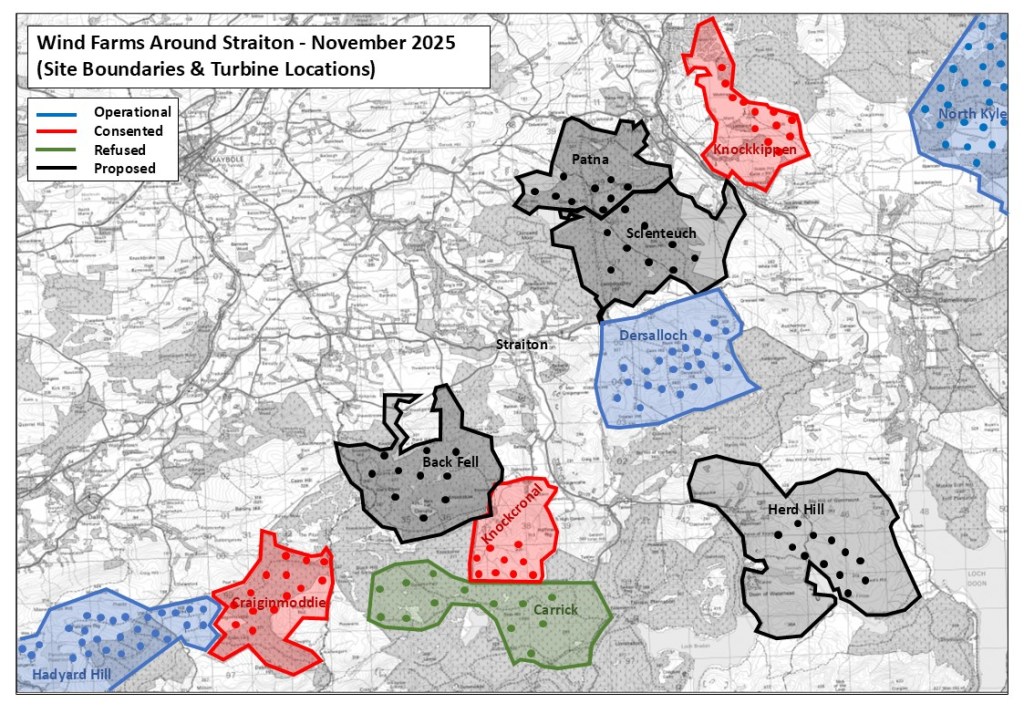


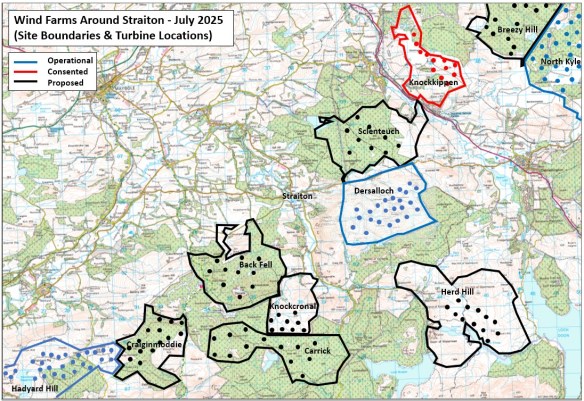




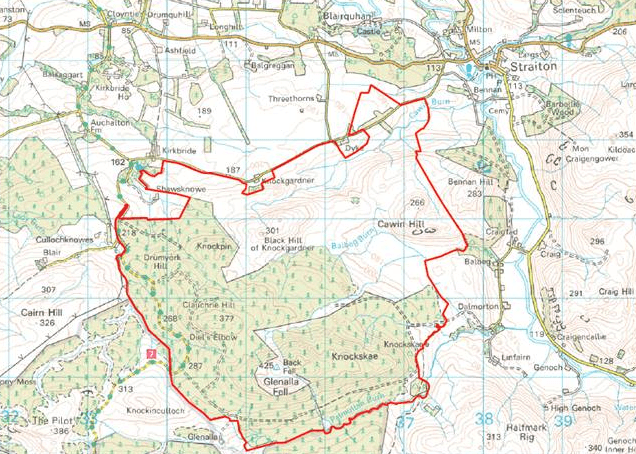








 Save Straiton for Scotland