

A Big Thank You to all who attended the AGM and Back Fell Wind Farm meeting yesterday, as well as those who spoke. Thanks also to the Afternoon Tea and Raffle teams, and the ‘Little Peru’ gang for their help with the clear up. It was great to see so many existing and new supporters. We really appreciate your time and effort.
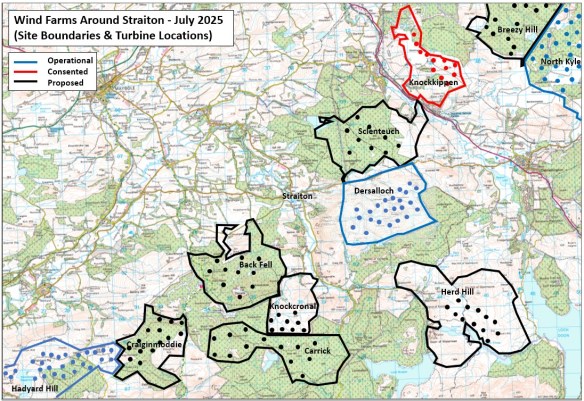
We’re posting below a couple of maps that were shared at the meeting which people found helpful in assessing the scale of proposed wind farm development in our local area, as well as across East Ayrshire. These include Back Fell and the recently announced Herd Hill and Breezy Hill applications. As we’ve said many times before, “Enough is enough!”
We’re also sharing below a YouTube video that was referred to showing how much concrete and steel goes in to the base of just one wind turbine. The turbines in the video are smaller than those proposed around Straiton, so there’d be even more concrete and steel.
When we were clearing up the hall after the meeting, we found an MOT test certificate from last week. If this is yours, let us know at savestraiton@gmail.com and we can get it back to you.
Finally, if you still haven’t objected to Back Fell, you’ll find all the information you need in the previous posts below.
 Save Straiton for Scotland
Thank you all for every thing you do for SSfS Would it be possible to send me the chart of windfarm generation in Scotland Thank you Ian Arnott
Has anyone considered asking for the help of King Charles as surely his property
Thank you for the invitation to the meeting yesterday, I found the presentations on the transportation issues and the one from the lady about the “timelessness” of Straiton and the surrounding areas very enlightening.
I believe the number of installed and proposed wind turbines in South-west Scotland to be driven by the Scottish Government need to generate income to fund the devolution of Scotland. The map which you have kindly attached to this e-mail, showing the huge number of installed and proposed turbines is not surprising. Below is a list of the interconnectors between Scotland and England and Scotland and Northern Ireland .
“Scotland has several electricity interconnectors, both existing and planned, that connect its grid with other parts of the UK and Ireland
. These interconnectors facilitate the transfer of electricity, allowing for greater energy security and the integration of renewable energy sources. The BBC reportedhttps://www.bbc.co.uk/news/articles/clynlkjp5m1o that a major subsea cable, Eastern Green Link 1, is under construction to connect Scotland and England, and another similar link, Eastern Green Link 2, is also planned.
Here’s a breakdown of the main electricity interconnectors in Scotland:
Existing Interconnectors:
*
Moyle Interconnector:
This is the only existing interconnector between Scotland and Northern Ireland, capable of transferring 500 MW of electricity. It connects Auchencrosh in Ayrshire, Scotland, with Ballycronan More in County Antrim, Northern Ireland.
*
Western HVDC Link:
A high-voltage direct current (HVDC) subsea link connecting Hunterston in Scotland with Flintshire Bridge on the Wales/England border. It is the first bi-directional subsea interconnector.
Planned Interconnectors:
*
Eastern Green Link 1:
This interconnector is under construction and will connect Torness in East Lothian, Scotland, with Hawthorn Pit in County Durham, England. It is a subsea cable project aimed at transporting green electricity for two million homes.
*
Eastern Green Link 2:
A planned second subsea link between Peterhead in Aberdeenshire and Drax in North Yorkshire, England. It is planned to be a 2GW high voltage direct current (HVDC) subsea transmission cable.
*
LirlC:
A proposed interconnector between Scotland and Northern Ireland, aiming to provide up to 700MW of capacity.
These interconnectors play a crucial role in the UK’s energy system, allowing for the exchange of electricity between different regions and facilitating the integration of renewable energy sources. They contribute to energy security by providing alternative sources of electricity and enabling the efficient transfer of power from areas with excess generation to those with higher demand. ”
So the fact that there are so many built and proposed turbines, in this area, is no surprise considering that the generated electricity can be easily transferred to Northern Ireland. Someone mentioned that there are no turbines on the Antrim coast. I would say this is probably why.
Once the infrastructure exists to transferred the generated electricity to Auchencrosh substation I suspect the flood gates will open (Although I sincerely hope not).
Your Faithfully
xxxxxx